
Suspension
Last on December 31 2015
Fiesta Mk1 Race/Rally specification suspension
This is the race/rally version of the suspension from Kustom Engineering. It features fully adjustable tie bars, with opposite threads on the heim joints, that allows the bar to be rotated to shorten/lengthen the tie bar in situ.January 2014 → Karl at Kustom Engineering is currently taking a break from making these kits, so they are not available to buy at the present time.


Making a FWD car go round corners
Since a FWD car is nose heavy, it must be setup to work the front tyres as evenly as possible. That means it must corner with the inside rear tyre very lightly loaded or airborne. We trade away lateral grip at the rear to gain more at the front, where we need it. We also gain drive traction on the inside front wheel. This is important in a FWD car, because we cannot use limited slip differentials that lock too firmly or abrubptly, unless the driver has great tolerance for steering fight.It is important to note that once the inside rear wheel is airborne, the rear suspension has contributed all the anti-roll moment it can, and any further roll resistance has to come from the front. Up to the point of rear wheel lift, rear load transfer builds faster than the front load transfer. Beyond that point, rear load transfer is 100%, and front load transfer builds rapidly. So does roll angle. So does understeer.
As a general rule, to get a car that has good consistency as grip varies, we want the inside rear wheel to lift just a little in steady state cornering, when grip is good. If it lifts more than that, we are likely to have a relatively loose car when grip is poor and a much tighter car when grip is good.
 Nov 2004: I am toying with the idea of fitting a softer front anti-roll bar to complement the rear.
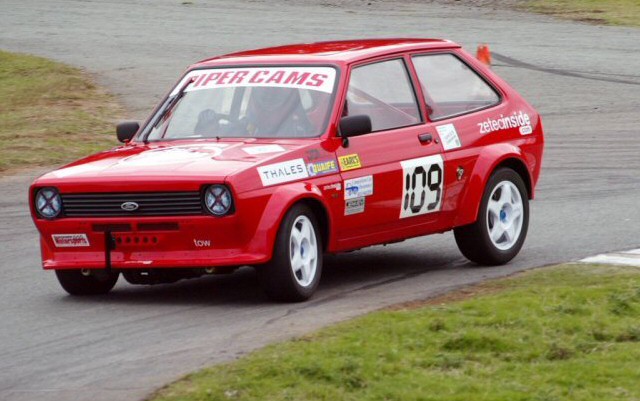 Now compare this picture with the one shown below, taken the year before, and you can easily see the difference in the body roll and the behaviour of the rear axle. Look at the gap between the rear tyre and the top of the wheel arch. The addition of the stiffer springs and rear anti roll bar have made the biggest differences. The -ve camber rear axle helps too.
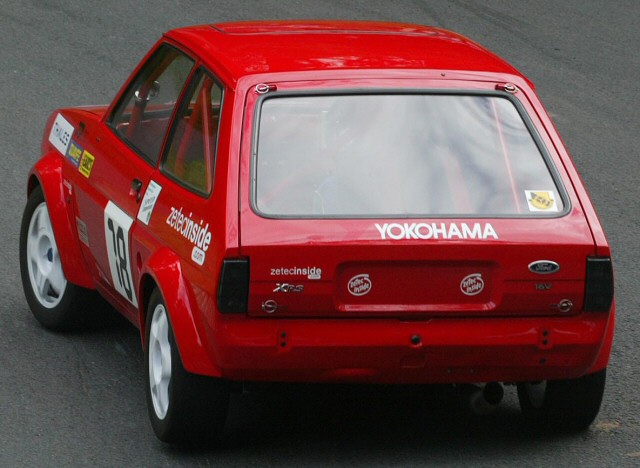 Finally, another picture showing the behaviour of the stiffer rear suspension, this time at Shelsley Walsh hillclimb, July 2004. The rear tyre is off the ground as the car approaches the top S at full speed.
How to make your Fiesta handle
Its all about preventing the shell from rolling too much, and trying to keep as big a contact patch at the front at all times (so you can keep the throttle pedal buried and get round corners even faster)Lets start with the rear of the car.
Rear suspension
Up to 2008, I ran with a Rutland Performance Vehicles rear beam, made to my specification. The standard tubular rear axle on the Mk1 Fiesta is a traditional design, shared amongst many manufacturers. Using a Panhard rod to keep the axle square to the ground, the system works quite well. Linked with an uprated rear anti-roll bar however, considerable improvements can be found, in keeping the car straight and level when cornering hard. I wanted to give the rear wheels some negative camber, and had thought about bending the axle, or cutting it in two, and using a steel sleeve, welding the axle back together, with a preset amount of negative camber.What I eventually settled on was a system that joined the two halves of the axle back together, but allowing adjustment of the camber and toe-in, in situ using two wedge shaped aluminium rings. The trick is machining the rings so when they're bolted back together, and sandwiched between the two halves of the axle, the resultant angle gives -1.5° negative camber on each wheel.
 This picture shows the end result. I also had the axle and all parts powder coated whilst it was away. And all fasteners are 12.9 grade steel for added strength and safety.
In 2009, I changed to a standard rear axle with Focus Mk1 stub axles bolted on to the ends of the Fiesta axle. This was again manufactured by Rutland Performance Vehicles. I went this route because I wanted to convert the Fiesta centre rear disk kit to use wheel nuts instead of studs. Drilling the rear hubs out to accept the Rally Design wheel bolts, cracked both of the rear hubs. Because the Fiesta Centre hubs are essentially made from 'turned down' Fiesta Mk1 rear drums, this exercise just showed how weak the cast drums actually are. So by moving to a Focus rear stub axles, and Focus hubs, I have removed the risk of the weak Fiesta centre hubs breaking whilst competing. As part of the conversion, I'm staying with rear disk brakes, and I'm now running a 'thinned and cross drilled' rear Focus disk, and a pair of underslung HiSpec single pot rear calipers. The benefit of running bolted on rear stub axles is that the camber can be altered by shimming the axles where they bolt on to the Fiesta axle, and I can also run Puma/Fiesta rear spacers, which means I no longer have to run wheel spacers trapped between the rim and the disks, which also helps reduce the rotating mass of the rear wheels.
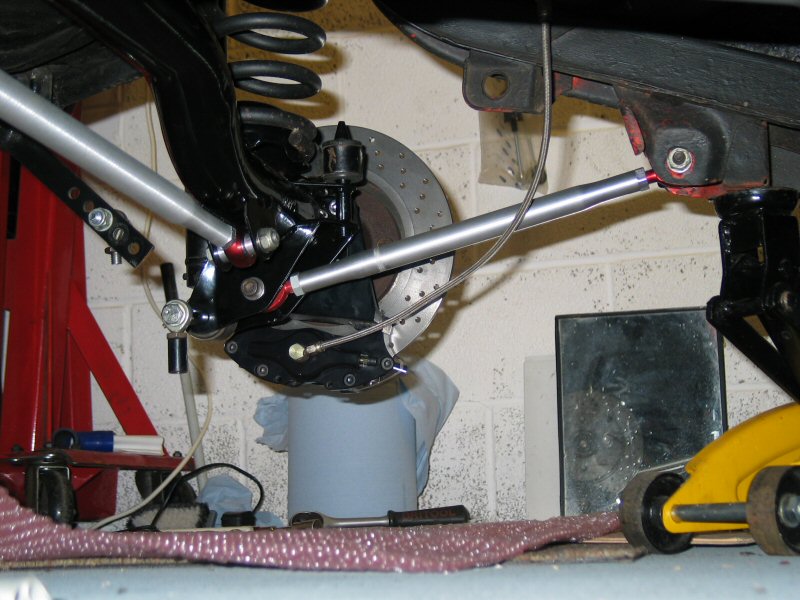

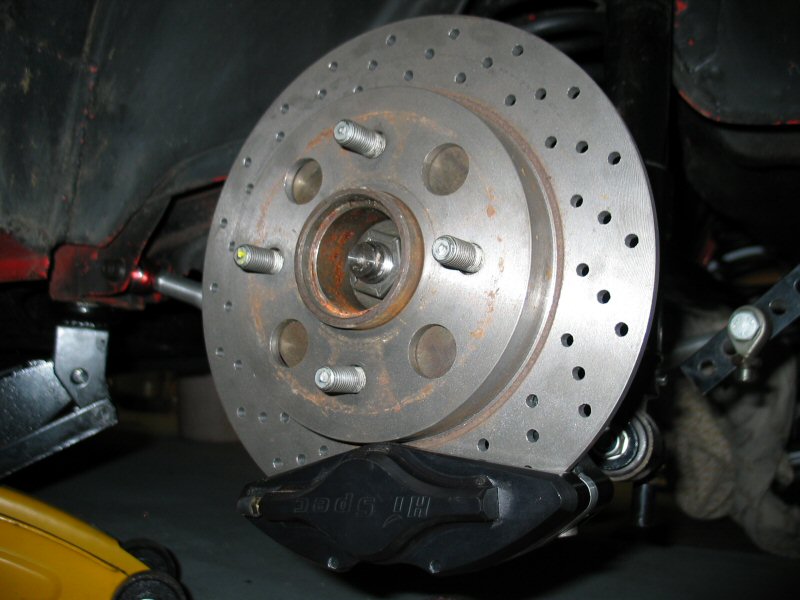
The Fiesta also has an adjustable aluminium panhard rod, supplied by Kustom Engineering (USA). And pair of Kustom Engineering aluminium adjustable rear trailing armsg. All the rod ends (heim) joints add up to a very noisy ride, but the suspension is completely adjustable and the settings cannot drift once adjusted.
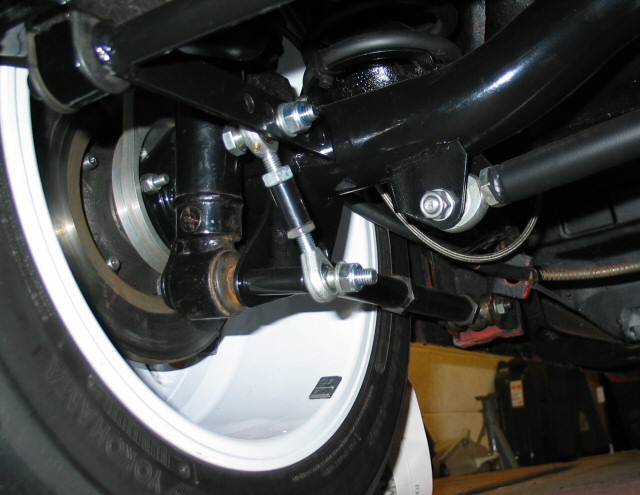 Since fitting the modified rear axle and anti-roll bar, I've adjusted the anti-roll bar drop links so that they are vertical when the car is sitting on all four wheels, which reduces the risk of the links binding and causing the rear end to lock up when cornering. I've also shortened the bar. As you can see, with five holes, the bar is rather close to the axle. By shortening the bar, I've reduced the number of adjustments available, but I still have from 5 times to 8 times the stiffness of the original XR2 anti-roll bar.
I'm using SPAX gas adjustable rear shock absorbers. Together with 450 pound shortened rear springs, and the anti-roll bar set on 5 times the stiffness of the standard anti-roll bar, the handling has been transformed. As you can see from the photograph below, the Fiesta now has a tendancy to lift a rear wheel on hard cornering. This is, believe it or not, to some extent desirable (read on...)
The front suspension
Over the years I've tried several different setups on the front. I first went for the Fiesta Centre 5sp fitting kit, but this ruined the handling as the car had no castor, and even Dave Walker from CCC magazine couldn't cure this.I then tried a custom made setup from Rutland Performance Vehicles, which simply transformed the handling, replacing the TCAs and the Tie Bars with heim jointed tubular steel arms and a lowered roll centre through the use of a spherical bearing to support the hub carrier. However, this solution wasn't capable of withstanding the abuse that the car took on kerbs, kept creaking all the time, and eventually failed at the Performance Ford track session at Snetterton in 2008 (without damage to the car thankfully).
The current setup, is a system supplied by Kustom Engineering, which overcomes all of the issues that we discovered using the RPV setup. However, the current problem is clearance with the passenger side tie bar, and the new Quaife sequential gearbox, and we're currently working on a solution. There isnt normally an issue with clearance, but the Quaife box is longer than the BC/IB5 so its a problem unique to my installation.
In the future I am going to explore moving to front wishbones, deleting the ties on both sides, but this is going to take some engineering to make it work, so could take a while to develop.
What has remained consistent with the front end, are the AVO adjustable shock absorbers, and the 275-300lb springs, which are required to take the weight of the Duratec and the heavier Zetec engine. At the front I tend to run zero toe-in, -1.5° camber and around 3.5° castor, when the suspension allows it.